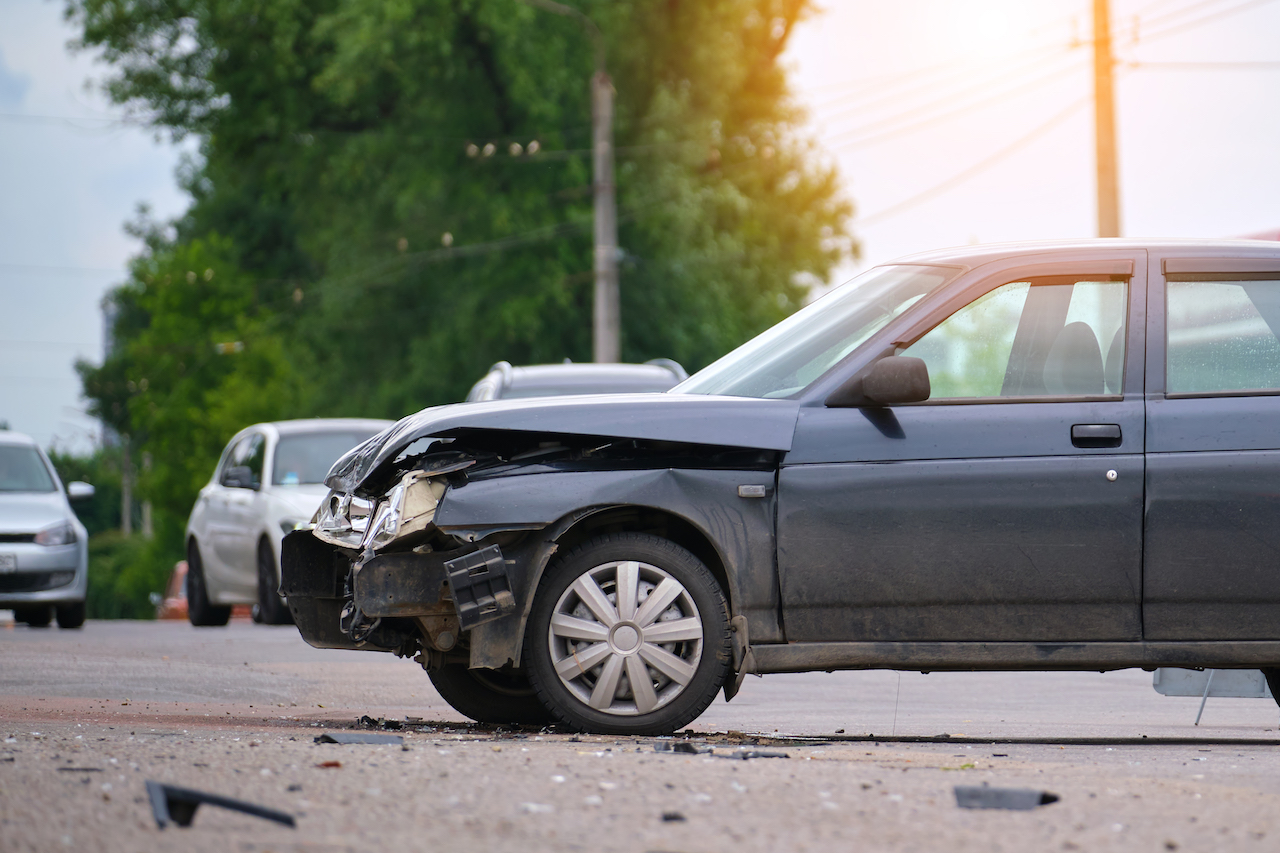
Episode 10: George S. Lamb is a Louisville attorney who handles motor vehicle accidents, in additional to his family law practice. In this episode, he’ll provide a basic overview of some of the key issues you need to understand about car wrecks, insurance issues and more. George will also provide specific tips to do at the accident scene.
The Importance of Insurance Coverage
George explains that if you’ve been injured in a car wreck, motorcycle accident or truck accident, much of the claim will revolve around insurance. Many people simply assume the other person’s insurance will cover everything. Let’s break down why this might not be true.
Assume the other person is at-fault in your collision (although proving liability can often be part of the challenge), the negligent driver’s insurance isn’t going to immediately cover your damages.
Kentucky is a no-fault state. Drivers in Kentucky are required to carry PIP coverage (Personal Injury Protection). There is an exception for motorcyclists. You’re required to have a minimum of $10,000 in PIP coverage. However, you can increase this coverage with your insurance company. PIP insurance (“no-fault coverage”) covers you and each of the passengers in your vehicle. This means each person would have access to $10,000 to cover medical expenses and lost wages related to the car wreck.
It’s important to understand you have a right to direct those benefits. Your attorney can help you to better utilize those funds. They can be used for lost wages, out-of-pocket expenses and medical expenses. PIP benefits enable you and your passengers to get medical treatment without having to wait until the entire claim is resolved.
Your medical provider is usually familiar with PIP. You’ll need to fill out an application, open a claim for your PIP benefits and follow a few steps. It’s fairly simple. Your provider can then accept the PIP coverage for the medical treatment provided.
Types of Insurance that may Apply to Your Situation
George explains how there can be layers of insurance you and/or your attorney will need to evaluate to see which applies to your situation. Generally speaking, there’s the insurance from the at-fault driver, then PIP, Under Insured Motorist Coverage (UIM) if the other driver doesn’t have enough insurance to cover your damages, and Uninsured Motorist Coverage (UM) will apply if the at-fault driver doesn’t have insurance.
The state minimum for liability coverage, in Kentucky, is $25,000. Each driver is required to carry at least that amount.
There’s also the issue of property damage (i.e. damage caused to your vehicle). The property damage claim is actually supposed to be paid immediately, by the negligent driver’s policy, assuming fault is established. That policy should cover a rental car. Their adjuster may have to evaluate the vehicle if a total loss is likely.
Considerations if You’re in an Accident while Traveling
If you live in Kentucky, but get into an accident outside of Kentucky, your insurance coverage will protect you, but the case will be handled in the state where the motor vehicle accident occurred. That state will have jurisdiction. George will be able to help you to find a reputable attorney in that state to represent you.
What about if you don’t live in Kentucky, but are involved in a car wreck in Kentucky? George could represent you, as it would be a Kentucky case.
Interestingly, you’d want the local attorney to help with various decisions involving PIP coverage. You may have other options in those other states.
Proving Which Driver Is At-Fault
This is the core issue for any motor vehicle accident. George explains you’ll need to prove the other driver was at fault. This entails proving he/she had a duty, that they breeched that duty, and that breech is what caused your damages. You’ll then need to provide the amount of your damages.
What if I Was At-Fault or Partially At-Fault for the Collision?
Not every case is simple. In Kentucky, we have pure comparative fault. This means that a percentage of fault can be allocated to both drivers, depending upon the facts of that particular wreck. It could end up that the fault is divided 90%-10%, 60%-40% or some other division.
In some states, if you’re at all deemed to be at-fault, you’re barred from bringing a claim. Other states have different levels of thresholds for fault. George uses an example of a state requiring the negligent driver must be at least 51% at-fault, for you to recover damages. Luckily, that’s not Kentucky’s system.
Again, we are a pure comparative fault state, based on your percentage of fault. This means your claim would be reduced based on the percentage of the fault you are proven to have.
Tips to Help if You’ve Been Involved in an Accident
George offers several tips you should consider at the scene of the motor vehicle accident. If possible, check to determine if everyone is okay. Call 911 if medical assistance is needed.
Tip #1
Don’t admit fault at the scene of the accident. Simply stick to the facts, not judgements, when you are talking to the police officer or the other driver.
Tip #2
Take photos of your vehicle and the other vehicle(s) involved in the collision, assuming you’re able and it’s safe to do so. You also want to take pictures of the scene around the cars. Was there ice on the road? Are there skid marks? Is there debris in the road? This will be important evidence.
Tip #3
Take pictures of injuries, when possible. These will heal and may not support your claim for damage, including pain and suffering, a few days/weeks later.
Tip #4
Try to get the names and contact information for any witnesses who may have seen the collision occur.
Tip #5
Call the police to have a police report taken at scene of the accident. The police report will be a helpful resource. You won’t get it right away. Make sure you get a report number from the officer. It will typically have insurance information from the other driver, where the vehicle is registered, the name of the owner of the vehicle, etc.
Tip #6
Seek medical treatment immediately. Remember, you have PIP coverage to handle those initial medical expenses. That’s why it’s there. Use a medical provider who is used to seeing motor vehicle accident patients. George recommends going to the ER. They will know how to handle your injuries and will have the proper medical equipment to do the imaging (e.g. x-rays), scans and other testing to properly diagnose your injuries.
Make sure you tell the doctor or nurse what happened and be specific about the injuries you have from the accident. Remember, your adrenaline will wear off and over the next several days, you may begin to feel worse than you did right after the wreck.
If you don’t go to the ER, you may choose to see a chiropractor. They often treat motor vehicle accident victims and they also understand the PIP claim process.
Is It Time to Contact George?
If you answered yes, the best way is to reach out to him on his cell phone at (502) 640-9797. You can call and/or text him. He’ll be happy to speak with you.
In the next episode, George will shift focus and provide information about Wills and Power of Attorney documents, so be sure to follow this podcast for new episodes.
We hope you enjoyed today’s episode. The information provided is not meant to be legal advice. Listening to this podcast does not establish an attorney-client relationship. However, if it is time for a lawyer, George is ready to listen. He’d appreciated it of you’d consider sharing this episode on your social media.
Going forward, we’ll launch a new episode every other week. You can connect with George on the firm’s Facebook page, on the website, as well as on Spotify, iHeartRadio, Apple Podcasts and other platforms. Lamb & Lamb, PSC is located at 4310 Robards Lane, in Louisville. The office phone number is (502) 451-6881.